Search This Blog

Showing posts with label Natural Wood. Show all posts

31 August 2011

"You can go your own way, go your own way"

Editors Note: This post will be a lot more fun to read if you can play this YouTube Fleetwood Mac video at the same time.


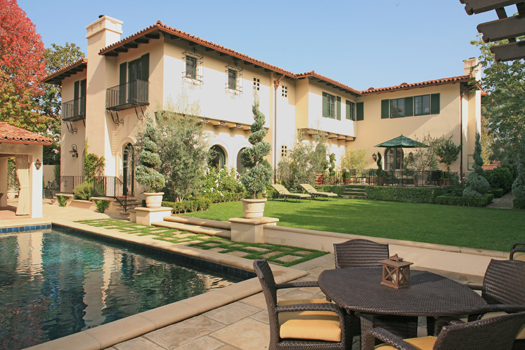
Fleetwood Macs' Lindsey Buckingham and his wife Kristen remodeled their LA house from the ground-up in 1999. The exterior of their newly rebuilt home was a mix of  Spanish/Mediterranean revival style. For the interior, they hired decorator Madeline Stuart.  


Elle Decor, Simon Upton

The outside architecture was influenced by Wallace Neff, the famous California architecture who built large houses that overlooked the Pacific ocean.


Elle Decor, Simon Upton
He became collectively known for his use of tiled roofs, wood front double doors, barrel-vaulted ceilings, wrought-iron railing stairways. His style was secured in the 50s.


Wallace Neff Designed Home, Source

Simon Upton Photgraphy
(And I love this photo because there's a black doodle in there too:)


Simon Upton

The Buckinghams house is easy on my eyes...to say the least! It's a great mix between fresh, ecclectic, balanced and rustic.


Simon Upton Photography, Madeline Stuart 


It isn’t one of those interiors that looks amazing in a magazine, but that’d be really hard to maintain its clean look. This home looks inviting, lived in, and natural.
There’s definitely a mood of eclecticism to this home. Simon Upton
Simon Upton Photography, Madeline Stuart Design
And I like that there’s dark, natural wood—unpainted. Why is it that more and more designers are painting beautiful wood?
Elle Decor, Simon Upton

Simon Upton

Kristen dedicated a few years transforming her home into something that radiated her authenticity and personal tastes. One of the things they worked hard at was finding unique, vintage pieces to fill the rooms. She became obsessed with locating certain elements, like the tobacco colored Terra-cotta floor and the reclaimed bricks.
Simon Upton

No doubt that it would be work to accumulate this style. Even with a large bank account.
What I found really intriguing about this story is that today, you can read about Kristen’s instinctive remodel of her home on the 1stdibs Introspective Magazine. Personally, I think if you make onto 1stDibs Introspective, by all accounts, you've made it as an artist.


Buckingham Garden, Elle Decor


Apparently, she gained a passion and, to some extent, a knowledge about decorating from the whole experience.
After Kristen finished her home, she liked it so much, she couldn’t let go. Today, you can find her decorating company has expanded to her opening a boutique.


About the store, she says


 “When I worked with Madeline on our first house, we would often design custom furniture whenever we couldn’t find anything to fit the bill. Whether it’s an idea that could be shaped into a new table or chair or a vintage objet d’art I found on my travels, I wanted to share the excitement I feel every time I see great design. This store fulfills this perfectly.”


K. Buckingham's LA shop
Although I imagine that doors open easier when your husband is a member of Fleetwood Mac, still, it requires interest, desire and discipline to continue the effort.


Elle Decor, Simon Upton

I really like what she’s done to her own home (with the help of Madeline Stuart), and I’ll be curious to see other homes she designs.


-Tara

18 August 2011

History Brush up on Mid-Century Modern Design- George Nakashima


George Nakashima (a Japanese American woodworker/architect) is, hands-down, one of my favorite names from the Mid-Century Circa. His unique furniture is famous for its use of large slab wood pieces with smooth tops and natural wood edges.  


George Nakashima graduated with a Bachelor’s in Architecture from University of Washington and his Master’s in architecture from M.I.T. by 1930. Although he started out as an architectural designer for larger scale projects, he later secured his passion on a much smaller scale with furniture.  


At the beginning of WWII, he opened a furniture workshop in Seattle with his wife but this was put on hold because they were interned in a camp like many Japanese Americans during the war. It was during this time that he was trained on salvaged wood by a master Japanese carpenter which sparked his interest in the unfinished, organic wood look.


“In dealing with solid wood almost each piece becomes a personal problem and the nature of each slab is used to its fullest capacity.”

-George Nakashima


George Nakashima often fixed cracks or filled voids using butterfly joints.

A close-up of Nakashima's signature butterfly joints.


In 1943, he and his wife resettled in Pennsylvania where he set up shop again. His shop employed some of the world’s finest craftsmen who devoted their time to Nakashima and his ideas, some of who still work in his studio today. Even though Nakashima passed away in 1990 at age 85, his work and his studio still live on through his daughter, Mira Nakashima-Yarnall.  


Some of his major commissions are listed below:
  • 200 furnishings for Nelson Rockefeller’s home in New York
  • Interiors for Columbia University
  • The Church of Christ the King in Katsura, Kyoto
  • The International Paper Corporation
  • Monastery of Christ in the Desert as well as the Alters of Peace
  • Series of furniture for Knoll


A plethora of Nakashima-inspired pieces...


Toodles,

Amy B.

06 July 2011

American Colonial Furniture and Antiques

Hope Y'all had a Happy Fourth of July!


This past Monday, after leaving the lake, I went with my dad to my grandparents home to pick up an old vanity that belonged to my grandmother. My grandfather had painted it with brown paint. It’s a heavy piece of furniture that I figure they purchased mid-century.


I am trying to decide whether to refinish myself or have it redone professionally. Here are some things that I will use to help me make my decision.


Antiques: 100 years or older. Restoring antiques should be left to the professionals. Restoring usually includes fixing broken legs, replacing hardware, repairing cracks, replacing trim pieces and fabrics with period detail. Basically anything that's required to get the piece of furniture as close to the original condition as possible is called restoration.


Refinishing can be as simple as stripping off the top layer of varnish, sanding, and applying a new one.


Contemporary American Colonial. Source


Steps to refinishing a piece.


1) Do a little research to determine its value, so you know whether or not you should try and restore it yourself.


There are a few things that you can look for to determine a piece of furniture’s age. Feel underneath—if the interior corners are sharp, then it's probably not an antique. Take out a screw and look at the threads. If they have inconsistent widths between them, then it's probably pretty old.


2) Clean Before You Start
A good place to start is to give it a good scrub with a sponge and some vegetable-based oil soap in warm water.


3) Sanding: start off with heavy-grit sandpaper, then move to finer grit.
Whether you're painting or staining, once you finish stripping and sanding, you'll want to give it another good cleaning. A clean surface is key to creating a professional finish.


4) There are many different kinds of stain, and each works best with different woods, so be sure to thoroughly research your options before proceeding.


So, as I’m cruising along the internet  ‘doing a little research’ I came across more information about wood. So I figured I’d post this information as a  continuation to  “What is Your Furniture Made of?” You can find more information from my source, here.


Before 1900 (20th century), most furniture was made with these woods:
  • Walnut, Oak, Mahogany, Rosewood, Fruitwoods, and rare wood veneers and inlays were common
American Colonial furniture, dependent on local availability, was made with maple, oak, walnut, birch, cherry, and pine. Because preferred furniture woods was readily available, (and less attractive/durable wood was only used for hidden, inside parts), pre-1900 furniture is almost always worth restoring.


Photograph by Miguel Flores-Vianna
As the 'preferred wood' became scarcer and more expensive, furniture started being made from more abundant woods, causing the traditional favorites to become rare.


The “more abundant woods” used today are
  • Ash, gum, poplar, pine, fir
How to Assess Wood
How do you begin to identify the type of wood used for your furniture? Ask yourself some key questions:
  • Consider the piece of furniture itself. About how old is it, and what style is it?
  • Look at the color. Although color can vary considerably from tree to tree, its tone is fairly constant within a species; the color intensity may change, but not the quality. 
  • Finally, look at the grain. Is the wood open- or close-grained? Are the pores evenly distributed, or are they concentrated at the growth rings? Is the grain straight or wavy, mottled or swirled?
Wood identification can sometimes be the deciding factor when you aren't sure if a piece is worth refinishing or if it should be thrown away. There's a good chance that a beat-up old dresser was built with what is considered a rare wood, today.


Wood Characteristics
A practical way to identify wood (and thus its value) is by its grain and color.


Wood grain and color: The cell structure of a tree, different for each species, determines its grain. Hardwoods have tubular cells called vessels that are visible as pores in the wood. If the cells are large, the texture of the wood is slightly rough, or open; a filler may be needed to smooth the surface. If the cells are small and has a smooth texture, described as close-grained, it doesn't require filling.


Open-grained woods: Oak, walnut, ash, mahogany, rosewood, and teak woods
Close-grained woods: Beech, birch, maple, cherry, satinwood, gum, and poplar woods
Furniture woods are chosen and valued for the character of their grain and color. This is why the old finish must be completely removed before you can tell for sure what wood a piece of furniture is made of.


Veneers
In old furniture, veneers and inlays of rare woods were often used to form designs or special effects. In modern furniture, veneers are used primarily where solid wood is unavailable or too expensive.
Veneers are fragile, and they can be damaged by refinishing techniques. Veneers are common in modern furniture construction, so take a good look at your furniture before you start to work on it. Any highly figured wood is probably a veneer.


Tips to determine if its vennered
  • Sometimes the veneer is visible at the edge of the wood surface, a thin layer glued over the base wood.
  • If you can't see a joint at the edge, look at an unfinished area under the piece of furniture. If the unfinished wood looks the same as the finished surface, the piece of furniture is probably solid wood. If there's a considerable difference, it's probably veneered.
Wood combinations: Many types of modern furniture are made with two or more kinds of wood, to keep costs down. Rare woods are used where appearance is important, such as table-tops; the more common woods are used for less conspicuous structural pieces, such as table and chair legs. This multiple-wood construction isn't always easy to see until the old finish is removed -- a table you think is walnut, for example, may turn out to have gum legs, stained to match.


This Corsican chair, found on 1st Dibs, is asymmetrical and made from an astounding array of hardwoods including:

Ask, Beech, Spalted Beech, Cherry, Cocobolo, Zebrano, Indian Rosewood, Oak, Birds Eye Maple, Sycamore, Yellow Box, Pau Rosa, Wenge, Padauk, Bubinga, Sapele, Mahogany, Pear


...But don't be mistaken, this chair was not made with all these woods to keep costs down!  It was done as a project and will cost you an arm and a leg...if you get a deal.


Back to my vanity at hand
It's a heavy piece of furniture. I scratched off some of the brown paint to view the wood underneath. It has a light reddish tint. First guess, I would say that my grandmothers vanity is a red oak, but it probably isn't old enough to be a traditional favorite. It could be beech, poplar, sycamore or willow. I need to investigate the grain more, but not until I can get the piece stripped. Although my grandmothers vanity probably isn't an antique or an American colonial, it's still a valuable piece to me.


Red Oak

Beech


Poplar

Willow


Sycamore


Tara